Build AI Apps on the Edge: A Step-by-Step Guide to Cloudflare Workers AI with Python & GLM-4.7-Flash
Managing dedicated GPU infrastructure for LLM inference is notoriously expensive and operationally complex. You have to provision clusters, configure autoscaling groups, and absorb the cost of idle capacity.
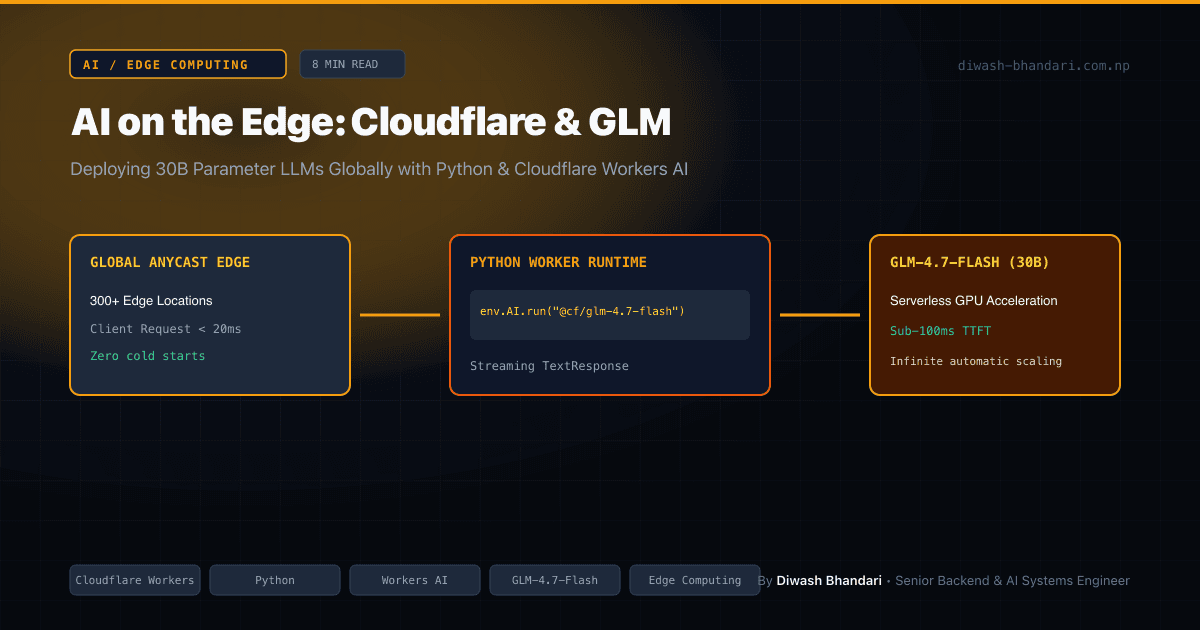
Cloudflare Workers AI changes the economics by offering serverless GPU inference deployed across Cloudflare's global Anycast network of 300+ cities. Combined with native Python runtime support and models like **GLM-4.7-Flash** (a 30B parameter multilingual model), you can ship edge AI applications with zero server maintenance.
Why Deploy Inference to the Edge?
Traditional AI applications route all requests back to a centralized cloud region (e.g. `us-east-1`). For users in Asia, Europe, or South America, round-trip latency alone can exceed 250ms before token generation even begins.
On Cloudflare Workers AI: - User traffic terminates at the geographically closest edge data center. - The Python worker initializes in milliseconds without cold start delays. - Streaming responses (SSE) deliver the first token to the client in under 100ms.
```
Client (Anywhere in the World)
              │  < 20ms Edge Roundtrip
              ▼
    Cloudflare Anycast PoP
              │
    Python Worker Environment
              │  Direct AI Binding
              ▼
    Serverless GPU: GLM-4.7-Flash (30B)
              │
    Streaming Response Back to Client
```
Setting Up the Project with Wrangler
Initialize a new project using Cloudflare's modern configuration:
```json
// wrangler.jsonc
{
  "name": "edge-ai-glm",
  "main": "src/entry.py",
  "compatibility_date": "2026-03-01",
  "compatibility_flags": ["python_workers"],
  "ai": {
    "binding": "AI"
  }
}
```
Writing the Python Edge Handler
Workers Python applications implement an async `on_fetch` entry point:
```python
from js import Response, Headers
import json
async def on_fetch(request, env): if request.method != "POST": return Response.new("Method Not Allowed", status=405)
data = await request.json() prompt = data.get("prompt", "")
if not prompt: return Response.new( json.dumps({"error": "Prompt required"}), status=400, headers=Headers.new({"Content-Type": "application/json"}) )
Invoke GLM-4.7-Flash directly through the AI binding messages = [ {"role": "system", "content": "You are a concise technical assistant."}, {"role": "user", "content": prompt} ]
output = await env.AI.run( "@cf/glm-4.7-flash", {"messages": messages, "stream": True} )
Return streamed text response directly to the client return Response.new( output, headers=Headers.new({ "Content-Type": "text/event-stream", "Cache-Control": "no-cache", "Connection": "keep-alive" }) ) ```
Production Optimization Tips
1. **Edge Caching**: For non-conversational deterministic prompts (such as sentiment classification or data extraction), cache model outputs using Cloudflare KV or Cache API. 2. **Context Budgeting**: Keep system instructions compact to ensure prompt pre-fill stays instantaneous. 3. **Fallback Routing**: Configure Workers AI multi-model fallbacks if higher rate limits are encountered during traffic surges.
Serverless AI on edge networks is the future of low-latency intelligent applications.
Interested in deploying scalable AI APIs? [Get in touch](/contact).