Prompt engineering focused on crafting optimal instructions for static model completions. But real-world business challenges require autonomous agents that reason, plan, invoke tools, verify outputs, and recover from runtime errors.
In modern agentic AI, software engineers structure systems using two fundamental design patterns: **Loop Engineering** and **Graph Engineering**.
Understanding Loop Engineering
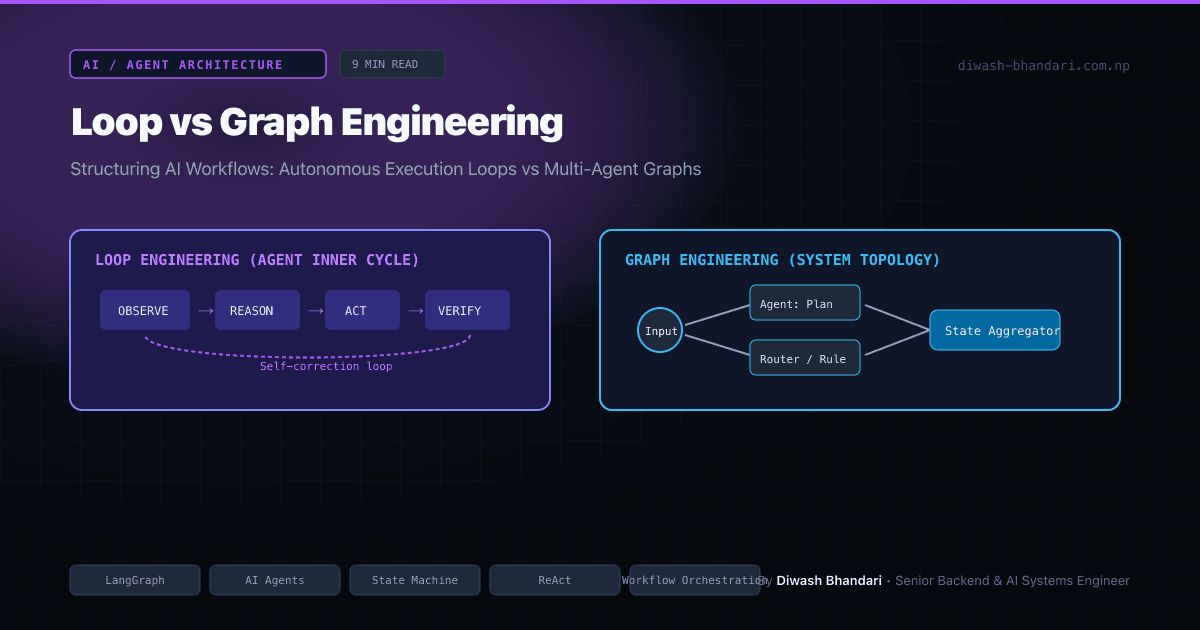
Loop Engineering governs an individual agent's inner cycle. It answers the question: *How does an agent repeat work until its output passes quality verification?*
An autonomous loop typically follows the Observe-Reason-Act-Verify paradigm:
```
┌────────────────────────────────────────────────────────┐
│               THE AGENT INNER LOOP                     │
│                                                        │
│  [OBSERVE] ──► [REASON] ──► [ACT] ──► [VERIFY] ──┐     │
│      ▲                                           │     │
│      └─────────── (Retry / Self-Correct) ────────┘     │
│                                           │            │
│                                     [Exit / Done]      │
└────────────────────────────────────────────────────────┘
```
Hallmarks of Loop Engineering: - **Autonomous Retries**: If a compiler or code linter returns syntax errors, the loop feeds the stderr back into context for immediate correction. - **Dynamic Tool Invocation**: The agent continues querying tools until it has collected enough facts to answer. - **Safety Termination Gates**: Strict bounds on maximum iteration count (e.g., `max_steps=10`) and token expenditure prevent runaway loops and billing spikes.
Understanding Graph Engineering
Graph Engineering operates at the macroscopic system topology level. It answers the question: *How do multiple specialized roles, human approval gates, and deterministic pipelines coordinate to solve cross-functional goals?*
Frameworks like **LangGraph** define explicit stateful directed acyclic graphs (DAGs) and cyclical state machines:
```typescript
import { StateGraph } from "@langchain/langgraph";
const workflow = new StateGraph(WorkflowState) .addNode("triage_analyst", triageStep) .addNode("security_gate", securityVerificationStep) .addNode("code_generator", codeGenAgentLoop) .addNode("reviewer", automatedCodeReview) .addConditionalEdges("reviewer", shouldDeployOrIterate); ```
Hallmarks of Graph Engineering: - **Deterministic Routing**: Complex business workflows (e.g. KYC compliance, financial settlements) require deterministic branching based on validated schemas. - **Checkpointing and Time Travel**: The system persists state at every node. If a cloud server restarts midway through an audit, execution resumes seamlessly without re-running earlier nodes. - **Human-in-the-Loop (HITL)**: Graphs can pause execution before critical write actions, awaiting human sign-off via webhook or Slack button.
Loop vs Graph: Comparison Matrix
| Dimension | Loop Engineering | Graph Engineering | |-----------|------------------|-------------------| | **Scope** | Microscopic (Single Agent) | Macroscopic (System Topology) | | **Primary Goal** | Self-correction until criteria met | Coordinated multi-stage pipeline | | **Control Flow** | Dynamic, LLM-decided next step | Explicit state machine & edges | | **Frameworks** | ReAct, Tool-calling loops | LangGraph, Temporal, AutoGen | | **Failure Mode** | Infinite loop / hallucination trap | Deadlock or misconfigured branch |
Hybrid Architectures in Production
Production systems rarely choose one over the other; they compose them. In systems like IntelliDocs and WACRM, the outer architecture is a **LangGraph state machine** ensuring compliance, security boundaries, and audit logging. Within specific task nodes, the graph launches **autonomous agent loops** to solve specialized sub-problems.
Mastering both is what distinguishes toy prototypes from battle-tested AI software.
Want to architect production-ready AI agents for your team? [Get in touch](/contact).