Prompt engineering taught us that phrasing changes how large language models respond. But as teams moved from conversational chatbots to autonomous agents and enterprise integrations, prompt engineering quickly hit an architectural ceiling.
You cannot prompt your way around missing database context, stale session memory, or mismatched tool schemas.
**Context Engineering** is the disciplined systems practice of designing, retrieving, filtering, and structuring the dynamic information payload that enters the LLM's attention window.
The Shift from Prompt to Context
```
PROMPT ENGINEERING:
"You are an expert SQL engineer. Generate a query for the orders table..."
(Static, handcrafted, brittle)
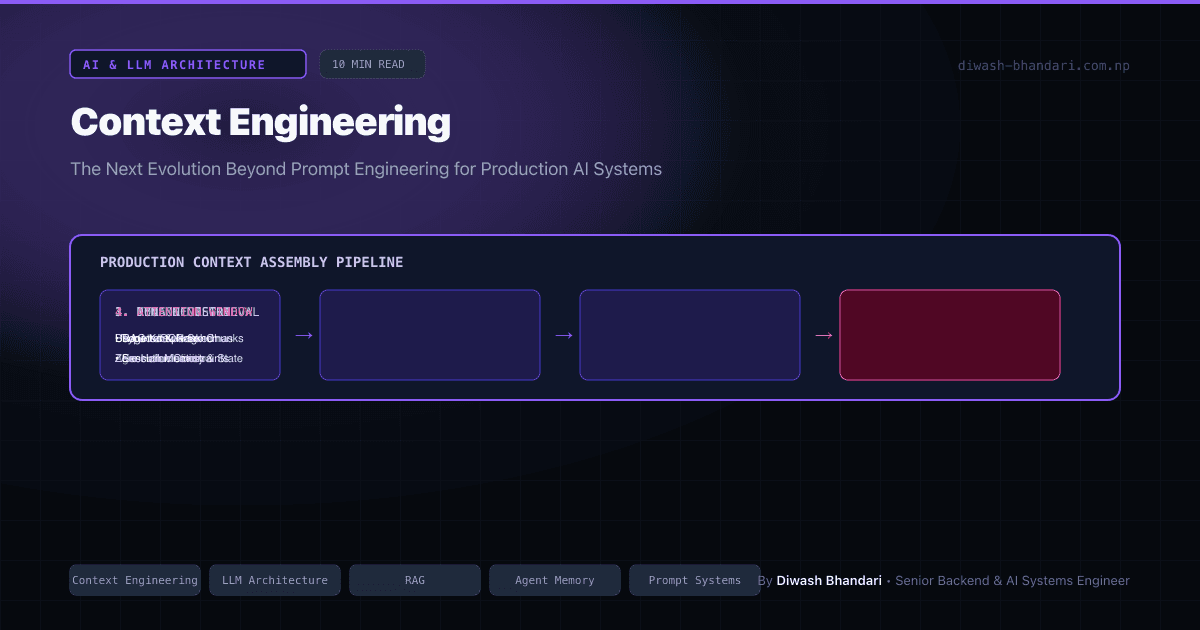
CONTEXT ENGINEERING: Dynamic Context Pipeline: 1. Parse User Intent & Permissions 2. Retrieve Schema (DDL + Constraints + Recent Partitions) 3. Fetch Session Memory (Previous clarifications) 4. Inject Exact Few-Shot Examples (Vector distance < 0.2) 5. Enforce Strict Token Budget Allocation ```
Pillars of Context Engineering
1. Vector Retrieval and Dynamic Windows Throwing 50 documents into a million-token context window degrades recall quality (the "lost-in-the-middle" effect) and skyrockets API costs. Context engineering uses hybrid search—exact entity lookup merged with pgvector embeddings—to deliver precise, relevant context chunks.
2. State & Episodic Memory Real users do not repeat themselves. A context engine manages rolling conversation summaries, working scratchpads, and long-term memory key-value lookups.
3. Tool and Schema Contracts Instead of free-form instructions, tools are provided as strictly typed JSON Schemas. Pydantic v2 validates inputs before and after model generation, ensuring that external tool calls never crash production services.
4. Token Budget Allocation Every token in your context window must justify its cost: - 15% System instructions & role bounds - 40% Retrieved factual documents / database records - 25% Session memory and historical tool execution results - 20% Reserved output budget for reasoning and response
Production Results
When we transitioned IntelliDocs from naive prompt templates to structured context engineering: - Hallucinations dropped by over 80%. - Average latency decreased by 45% due to reduced prompt tokens. - Tool invocation accuracy reached 99.4% in CI evaluation suites.
Bottom Line
Models are becoming commoditized; the competitive advantage lies in the engineering of the context you provide them.
Building production AI platforms with reliable context pipelines? [Get in touch](/contact).