For over a decade, Python package publishing felt like a patchwork of conflicting tools. You used `setuptools` for building, `virtualenv` for environments, `pip-tools` for locking dependencies, and `twine` for uploading distributions to PyPI.
With the release of **Astral's uv**, Python packaging has finally achieved its "Cargo moment". Written in Rust, `uv` replaces `pip`, `poetry`, `flit`, and `twine` with a single, blazingly fast executable.
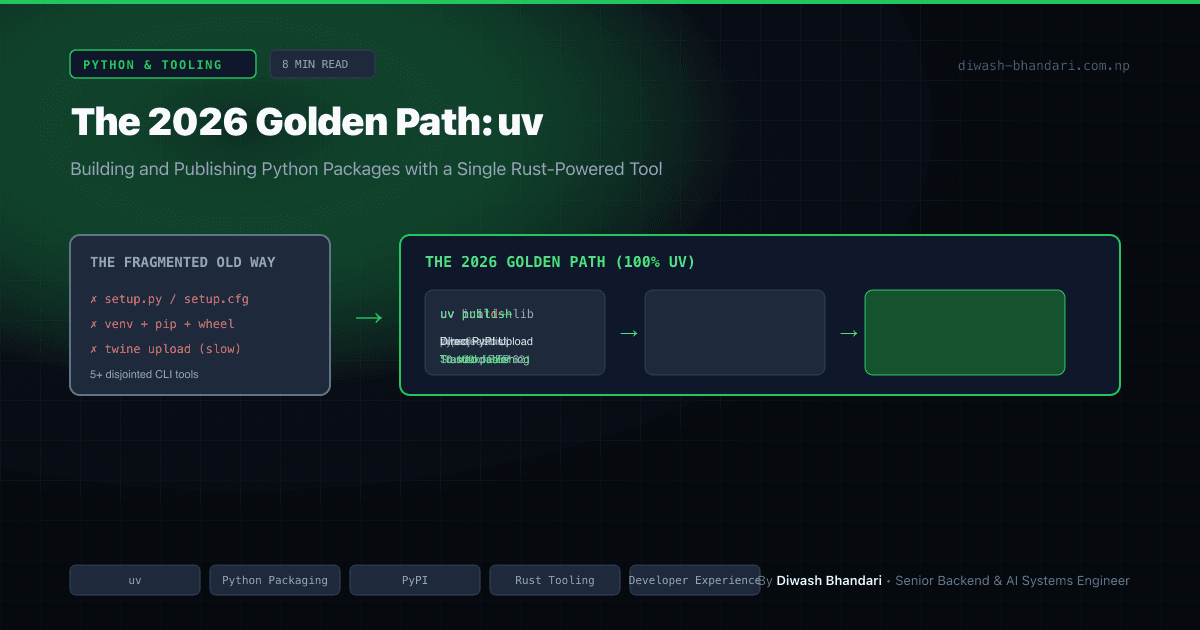
The Old Way vs The 2026 Golden Path
```
THE LEGACY MESS:
python -m venv .venv
source .venv/bin/activate
pip install wheel build twine
python -m build
python -m twine upload dist/*   (Slow, manual credential handling)
THE 2026 GOLDEN PATH (100% UV): uv init --lib my-library uv build uv publish ```
1. Initializing a Standard Modern Package
Create a package structured around PEP 621 standards:
```bash
uv init --lib guard-trust-sdk
cd guard-trust-sdk
```
This generates a minimal, clean `pyproject.toml`:
```toml
[project]
name = "guard-trust-sdk"
version = "0.1.0"
description = "Offline license validation and hardware fingerprinting SDK"
readme = "README.md"
requires-python = ">=3.10"
dependencies = [
    "cryptography>=42.0.0",
    "pydantic>=2.7.0",
]
[build-system] requires = ["hatchling"] build-backend = "hatchling.build" ```
2. Managing Environments and Dependencies
Add runtime dependencies and development tools effortlessly:
```bash
# Add production dependency
uv add httpx
Add development / testing dependencies uv add --dev pytest ruff mypy ```
`uv.lock` ensures byte-for-byte reproducibility across local workstations, CI runners, and deployment containers.
3. Building Wheel and Source Distributions
To build your package artifacts:
```bash
uv build
```
Within milliseconds, `uv` creates standard `.whl` and `.tar.gz` distributions in the `dist/` directory:
```
dist/
├── guard_trust_sdk-0.1.0-py3-none-any.whl
└── guard_trust_sdk-0.1.0.tar.gz
```
4. Publishing to PyPI
Publish directly with automated token handling:
```bash
# Upload to PyPI
uv publish --token $PYPI_API_TOKEN
```
For CI/CD workflows, configure GitHub Actions Trusted Publishing (OIDC) so no long-lived API tokens are stored in repository secrets.
Performance Benchmark
In CI pipelines: - **pip + build + twine**: 45 to 70 seconds. - **uv build + publish**: Under 2.5 seconds.
Bottom Line
If you are still maintaining legacy `setup.py` scripts or running multiple disparate CLI utilities, moving to `uv` will instantly simplify your developer workflow and accelerate your CI release pipelines.
Looking to optimize Python infrastructure or package architectures? [Get in touch](/contact).